Study: For Some Symptoms, Medical Marijuana With THC Is Better Than CBD – Forbes

The cannabis plant has hundreds of “active ingredients,” but the two most prominent—and the only two most people have heard of—are THC and CBD.

Despite “medical marijuana” laws specifically allowing people to access cannabis products containing THC, over the past few years, one line of conventional wisdom goes something like this: THC is the molecule that gets you high; CBD is non-psychoactive and promotes healing.

Since federal law allows CBD but still bans more than a minute amount of THC, in some circles, the dichotomy has devolved further to some version of “THC is for fun; CBD is for medicine.” (Certain CBD companies take this too far and make all kinds of outrageous product claims, prompting warnings from the Food and Drug Administration.)

But as a recent study highlighted, this understanding is wrong. THC is also medicinal—and in fact, cannabis users seeking prompt, effective relief from nausea want more THC, and less CBD.

In what’s been described as “the largest study of its kind,” researchers at the University of New Mexico have been tracking via an app cannabis users’ habits: symptoms, cannabis product selections, and subsequent experience of relief (or not).

MORE FOR YOU

They found that cannabis users using the drug to soothe symptoms of nausea found relief in as quickly as five minutes—but they also found that users smoking joints of cannabis flower achieved more relief, and more quickly, than someone using a vaporizer or using edibles.

Most surprisingly, they also found that products with higher THC content were more effective than products high in CBD. In fact, users of cannabis products high in CBD achieved on average less symptom relief, according to research published in April in the Journal of Clinical Gastroenterology.

As Jacob Vigil, an associate professor of psychology at the University of New Mexico and a study co0-author told the school’s news website, “perhaps our most surprising result was that THC, typically associated with recreational use, seemed to improve treatment among consumers of Cannabis flower, while our CBD, more commonly associated with medical use, actually seemed to be associated with less symptom relief.”

The study analyzed “2220 cannabis self-administration sessions” from 886 users seeking relief from nausea between June 6, 2016 and July 8, 2019. Users reported what products they were using, what symptoms they were trying to alleviate, and then tracked how the cannabis product affected their symptoms in real time.

Interestingly, they found that flower products labeled sativa or hybrid “outperformed” products labeled indica (itself a flawed taxonomy, but that’s a separate story). And “In sessions using flower, higher tetrahydrocannbinol and lower cannabidiol were generally associated with greater symptom relief (eg, within 5 min),” the study authors reported.

While welcome news to anyone extolling THC’s medical benefits—and a fine opportunity to refine our understanding of CBD—the study isn’t all good news, the authors cautioned. THC’s long-term effects on “high-risk populations,” including pregnant women and children, who may be compelled to use cannabis, creates “concerns,” as study coauthor Dr. Sarah Stith, an assistant professor of economics at the University of New Mexico and the lead study author, said in a release.

It also bears mentioning that nausea is just one symptom, and that there are others that CBD may be more effective in relieving than THC.

But at the least, findings like this should promote a fuller understanding of cannabis and its constituent parts. It should also encourage anyone hearing the “THC for partying, CBD for healing” line to put it where it belongs: in the trash bin.

Escondido Won’t Budge On Cannabis Dispensaries Ban – KPBS

A marijuana bud on display at Hidden Leaf Collective, May 28, 2021.

Photo by Alexander Nguyen

Above: A marijuana bud on display at Hidden Leaf Collective, May 28, 2021.

Despite most Escondido residents voting for Proposition 64 to legalize recreational cannabis in 2016, you still won’t be able to find a legal dispensary in the city.

On May 19, the city council voted 3-2 to continue a prohibition on legal cannabis dispensaries. Though the county recently voted to allow dispensaries in unincorporated areas, Escondido is not alone as San Marcos has a similar ban.

Karla Aguilar said continuing the ban will only hurt those on the bottom rungs of society. People of color have traditionally been targeted by law enforcement during the war on drugs and Aguilar said this will continue to widen the inequity.

„The lack of dispensaries and access to cannabis has become devastating especially for BIPOC (Black, Indigenous, People of Color) communities who do not have reliable transportation to drive upwards to 30 minutes to obtain cannabis,” she said.

Marcello Castillo, co-owner of the medical cannabis delivery service Hidden Leaf Collective, was disappointed with the council’s vote after he had lined up a location and lease to open a new store in the city. But Castillo said he understands where the council was coming from.

“It really kind of put us down a little bit but then also we had a kind of think about the perspective of why Escondido City had done that,” he said. „And we were thinking, well you know it is kind of a good benefit for the for that particular city in some areas too because of the high crimes and things like that.”

An increase in crime was one of the reasons some residents said they were against lifting the ban. According to the February 2021 report by the Cato Institute, a Libertarian think tank, violent crimes have neither increased nor decreased significantly in places where cannabis is legal.

There is some evidence, however, that teens are using pot more, post-legalization. A November 2020 SANDAG report shows 57% of teens arrested in 2019 tested positive for cannabis — a 19-year high.

RELATED: Driving Stoned: San Diego Scientists Try To Find DUI Limit For Marijuana

That’s the reason why Daisy Ponce, a junior at San Pasqual High School, told the council she does not want dispensaries in the city.

“I get to see a lot of kids intoxicated in class and it’s not a good feeling to have one of those things in the class,” she said. „Adding cannabis dispensaries in Escondido will only normalize the use of marijuana even more.”

But by continuing with the status quo, Councilmember Consuelo Martinez said the city is at risk of proponents putting the measure on the ballot. She, along with Mayor Paul McNamara, were the two dissenting votes.

“I see that dispensaries will eventually come to the city of Escondido,” Martinez said. „For me, it’s really an issue of do we want to get ahead of that issue and have a say where, how many of those dispensaries it would exist in our city.”

By extending the ban, Castillo said the council also missed an opportunity for added tax revenues and jobs in the area.

“It is sad because it will bring a lot more people into the community to spend our money inside that particular city and it will increase the taxes of it,” he said.

Michael Morasco, Escondido Deputy Mayor, was not swayed by that argument. He said it’s the same principle as not wanting tax revenue from prostitution or gambling.

FEATURED PODCAST

San Diego News Now podcast branding

San Diego news; when you want it, where you want it. Get local stories on politics, education, health, environment, the border and more. New episodes are ready weekday mornings. Hosted by Anica Colbert and produced by KPBS, San Diego and the Imperial County’s NPR and PBS station.

Curious San Diego banner

To view PDF documents, Download Acrobat Reader.

American Cannabis Companies Continued to Consolidate in May – New Cannabis Ventures

The American Cannabis Operator Index fell for the third straight month after having scored five straight monthly gains, declining 2.3% to 77.86:

After gaining 45.7% in 2020, when it ended at 63.05, the index is up 23.5% in 2021 and has gained 157.8% over the past year:

The index, which launched at the end of October 2018 with a value of 100, reached a closing high of 124.16 a week later before declining to 70.64 in late December 2018. It then rallied as high as 119.53 in early April 2019 before selling off over the balance of the year and into March 2020. It has rebounded 437.0% from an all-time closing low on March 18, 2020 at 14.50:

During May, the index included 29 companies, including 25 multi-state operators (MSOs) and 4 focused solely on CBD extracted from industrial hemp. 5 companies posted double-digit returns, while 11 declined by more than 10% during the month:

The four best performing stocks in May included Marimed (OTC: MRMD), Harvest Health and Recreation (CSE: HARV) (OTC: HRVSF), Charlotte’s Web (TSX: CWEB) (OTC: CWBHF) and Vireo Health (CSE: VREO) (OTC: VREOF). Year-to-date, Marimed has gained 134%, Harvest has increased 92%, Charlotte’s Web has rallied 45%, and Vireo has jumped 43%.

The four worst performing stocks during the month included HempFusion (CSE: CBD.U) (OTC: CBDHF), the worst stock in April as well, cbdMD (NYSE American: YCBD), MedMen (CSE: MMEN) (OTC: MMNFF) and The Parent Company (NEO: GRAM.U) (OTC: GRAMF). HempFusion has lost 30% since its IPO earlier this year. cbdMD has gained 3% year-to-date, while MedMen is up 117%. The Parent Company has declined 39%.

For June, the index will include 30 stocks, with Terra Tech (OTC: TRTC) removed after no longer meeting the minimum price required for inclusion as of May 26th. Joining the index for the first time will be Gage Growth (CSE: GAGE) (OTC: GAEGF), while Chalice Farms (CSE: CHAL) (OTC: GLDFF), formerly Golden Leaf Holdings, returns following its reverse split.

In the next monthly review, we will summarize the performance for May and discuss any additions or deletions. Be sure to bookmark the page to stay current on American cannabis operators stock price movements within the day or from day-to-day.

Get ahead of the crowd by signing up for 420 Investor, the largest & most comprehensive premium subscription service for cannabis traders and investors since 2013.

Alan Brochstein, CFA
Based in Houston, Alan leverages his experience as founder of online community 420 Investor, the first and still largest due diligence platform focused on the publicly-traded stocks in the cannabis industry. With his extensive network in the cannabis community, Alan continues to find new ways to connect the industry and facilitate its sustainable growth. At New Cannabis Ventures, he is responsible for content development and strategic alliances. Before shifting his focus to the cannabis industry in early 2013, Alan, who began his career on Wall Street in 1986, worked as an independent research analyst following over two decades in research and portfolio management. A prolific writer, with over 650 articles published since 2007 at Seeking Alpha, where he has 70,000 followers, Alan is a frequent speaker at industry conferences and a frequent source to the media, including the NY Times, the Wall Street Journal, Fox Business, and Bloomberg TV. Contact Alan: Twitter | Facebook | LinkedIn | Email


Get Our Sunday Newsletter


UK cannabis campaigners take note: in the US, change came from below – The Guardian

Take a stroll down Abbot Kinney Boulevard, the high street for hipsters in Venice Beach, California, and alongside the brightly painted boutiques offering vintage T-shirts or oat-spiced lattes, you’ll find a sleek, bright red storefront with plate-glass windows that, at first glance, is easy to mistake for a car showroom.

Instead of cars, though, it sells high-end cannabis products: Huckleberry Gummies, Keef root beer, concentrates, creams and lotions, rolled joints and vaporisers, all laid out on carefully curated wooden tables. This is MedMen, part of a national chain of quality pot shops that constitute the normal now that cannabis is authorised for recreational and medical use in California and 16 other states.

Sadiq Khan, the mayor of London, may have pledged to set up an independent commission to study decriminalisation, but to anyone familiar with the largely stalled debate over cannabis in Britain, the proliferation of legal pot shops along well-trafficked thoroughfares is an exotic and improbable sight. California is far from a perfect model to follow, not least because of its ferociously complex patchwork of regulations and requirements that vary from city to city, and other states have struggled with their own problems in setting up the infrastructure of a newly legal industry. Having set off down the road toward full legalisation almost 30 years ago, though, America does have some salient lessons to offer.

First, contrary to the fears of drug alarmists, the ready availability of cannabis products has not been shown to have any significant effect on crime, addiction or traffic accident statistics. Rather, if established and regulated properly, the legal market brings a previously clandestine activity into the open and makes it safer and more accountable.

Second, there’s no virtue in half-measures. Like Britain, many US states started off attempting to restrict legalisation to medical use. But it was only after Colorado and Washington became the first states to open to legal recreational use in 2012 that any meaningful market emerged to challenge the old criminal networks.

A medical marijuana market may have been a theoretical possibility, but in practice government agencies have been reluctant to create one because many of the key decision-makers continued to feel that cannabis was – to use Boris Johnson’s term – a “harmful substance”. At the same time, doctors with no training in the drug’s uses felt no compulsion to prescribe it, which is exactly what Britain has experienced since giving the green light to medical use in late 2018.

In many ways, the UK is now where the US was 20 years ago, when the only legally recognised distributor of medical cannabis was, improbably, a lab at the University of Mississippi in the ultra-conservative deep south that proved powerless to challenge the long-established dominance of the black market.

The lab didn’t manufacture suppositories or gels or edibles. It made no effort to separate out THC, the psychoactive ingredient that gets users high, and cannabidiol, or CBD, whose benefits are said to include everything from pain relief and heart health to treatment for depression, diabetes and acne.

Rather, the lab sent out metal canisters, each containing 300 rolled joints for recipients to use as they saw fit. Many of them would unroll the joints again to pick out seeds and other extraneous material that didn’t burn smoothly, and even then they complained that the cannabis itself was of low quality.

As of the early 2000s, just four people were receiving this service – out of a population then pushing close to 300 million. Those dismal numbers are broadly in line with the findings of a report by a UK cannabis industry group last month that said NHS doctors had issued just three cannabis prescriptions in the two years since legalisation, and private-sector doctors had written just a few thousand. An estimated 1.4 million people, meanwhile, are estimated to be self-medicating with cannabis bought off the street.

Lesson number three from across the Atlantic is that the most effective way to break an impasse of this sort is through pressure from below – much as Sadiq Khan is seeking to pressure the government with his commission. Building a legal cannabis industry from scratch is a daunting prospect – much harder than it was, for example, for the United States to re-regulate the alcohol industry after the end of prohibition in the 1930s – and governments have a natural tendency to prefer the status quo, however unsatisfactory or unpopular, to plunging into the unknown.

Since the 1990s, the pressure for change in the US has come through popular referendums, known as ballot initiatives, that have set pioneering states such as California and Colorado on a collision course with the federal government. One of the peculiarities of the US system, in fact, is that while much of the country has approved legalisation of cannabis, the federal government still regards it as a controlled substance to be used only in tightly defined circumstances. That, in turn, has forced the new wave of entrepreneurs to operate in a weird legal limbo, caught between state and federal systems. Many of them are cash only, since the federal government sets banking rules, and they are unable deduct most business expenses from their federal taxes.

Still, the tide is slowly turning. Business operators are no longer at risk of being raided by federal agents, as they were in the 1990s and early 2000s, and industry lobbyists have been working steadily to relax the banking rules.

Which leads to lesson number four: that even under the best of circumstances the legalisation process is likely to be lengthy and complicated. It’s no coincidence that in California the most visible businesses are at the luxury end of the market. Red tape and high taxes have scared many other operators away, to the frustration of entrepreneurs in lower-income, African American communities that were hit hard by America’s long, punitive war on drugs and are now yearning for some modicum of compensatory justice. Instead, they see a black market continuing to thrive.

The point, though, is to start somewhere. In the early days, Washington told many states – just as Downing Street has told Khan – that campaigning for broad legalisation was a waste of time because they didn’t set drug policy. If the states had listened, US consumers would never have gained access to the sort of high-quality products and expert guidance available at MedMen and other outlets. They’d still be waiting for their canisters from the University of Mississippi – or, more likely, scoring their hits on the street.

These Canadian Cannabis Producers May Benefit From an Israeli Medical Innovation – The Motley Fool

According to Health Canada, the Canadian medical cannabis market currently contains 320,000 registered patients, and an estimated total of 8 million Canadians experience chronic pain. An Israeli pharma-tech, Syqe Medical, which specializes in inhalation devices for therapeutic drugs, has developed an innovative medial cannabis inhaler — touted as a first of its kind — to help treat these patients. During its announcement of regulatory approval in Canada on April 28, the company did not name a licensed producer. However, there is reason to believe that the licensed producer could be a North American cannabis operator headquartered in Canada called TerrAscend (OTC:TRSSF).

The Syqe Inhaler is devised to provide metered doses of aerosolized cannabinoids to the lungs with minimal patient training. The inhaler allows for self-administered doses effective in relieving pain while strongly limiting unwanted side effects such as psychoactivity, which comes from high levels of tetrahydrocannabinol (THC). The company’s clinical trials show that its inhaler usage has homed in on what’s called a therapeutic window of 500 micrograms of THC per dose. By comparison, patients who smoke medical cannabis as a treatment are at risk of administering 300 times those levels, which can lead to unnecessary side effects.

Young lady holding a marijuana leaf in a field of plants.

Image source: Getty Images.

Syqe Medical’s approval in Canada follows its European regulatory certification. The company is currently looking at ways to introduce the product, along with accompanying cannabis cartridges, into the acceptable groups of health services covered by healthcare organizations in Israel. For example, in Canada, synthetic cannabinoids are used for neuropathic and cancer pain, HIV-related anorexia, and chemotherapy-associated nausea. The costs for such products are covered by health insurance companies. In Israel, health insurance coverage is more widespread for medicinal cannabis and covers areas such as vaporizers. As Syge Medical continues with those plans to fit the product into a group that is covered by health insurance in Canada, it is looking to start marketing the inhaler in the country at some point in 2021.

The licensed producer that ends up working with Syqe will not only get a first-of-its-kind product, but will also be working with a company listed as one of the top 10 most innovative biotechs of 2020 by Fast Company. It’s worth noting that Syqe was listed as No. 7 on that list, which was led by Merck and Sage Therapeutics at Nos. 1 and 2, respectively.

As mentioned, no licensed producer has been named in Syqe’s recent announcement of plans for sales to the Canadian market. But Syqe and TerrAscend did announce an exclusive distribution agreement in September 2019 to bring the Syqe Inhaler to Canada. That agreement states that TerrAscend will lead the marketing, distribution, and sales efforts across Canada.

TerrAscend can provide retail and distribution through its branded portfolio, which includes Ilera Healthcare, the Apothecarium Dispensary, and Arise Bioscience. In addition to its Canadian operations, the company has established itself in the U.S. cannabis market with vertically integrated operations in California, New Jersey, and Pennsylvania, where  it recently doubled its number of dispensaries through acquisition.

Management’s strategy to expand the company’s footprint and develop into a market leader is progressing well, though revenue isn’t quite up to the numbers brought in by competitors such as Curaleaf, which rang up over $250 million in the first quarter of 2021 alone.

TerrAscend’s full-year 2020 net sales came in at $198 million, amplified by fourth-quarter results of $65 million, for a sturdy 28% growth rate quarter over quarter and 152% year over year. Fourth-quarter margin of 40% also expanded sequentially, compared with 35% and 24% for the third and second quarters, respectively.

At the end of 2020, management called for an increase in net sales of 87%, to $270 million, for full-year 2021. So far, the company is on its way to hitting — and possibly topping — that guidance. First-quarter sales came in at $53.4 million, an increase of 106% over the same quarter in 2020, while gross profit margin increased by 20% over last year. And while 2020 saw a net loss of $87.8 million for the year, after one quarter of 2021 the company is looking at a current loss of $12.7 million. Now management has once again raised their full-year guidance for sales to exceed $300 million, driven by increased capacity across each of its U.S. facilities, in addition to contributions in Canada from a streamlined product portfolio and cost-cutting measures.

TerrAscend’s success has not gone unnoticed in the industry. In February, Canopy Growth (NASDAQ:CGC) closed on a purchase of additional shares of TerrAscend, bringing its total ownership to 20% of outstanding shares.

This connection could potentially provide Canopy with an inside track to a piece of the Syqe Medical Inhaler sales. Canopy Growth already serves the Canadian medical market, and has international distribution agreements for medical cannabis. Given its investment relationship with TerrAscend and its robust distribution channels, Canopy could provide investors with sleeper potential to form licensing and distribution relationships with TerrAscend or possibly Syqe Medical directly over time.

If TerrAscend can make things happen with this top biotech company, it could be a boost that helps catapult the company into the sales universe of competitors like Curaleaf. But if it doesn’t, the company is still supported by sturdy numbers and momentum to show what it can do with what it already has. Tremendous revenue and margin speaks volumes across the young and competitive cannabis market. If TerrAscend can hit the guidance numbers presented to the public, and carry its momentum into the second quarter, it might be a good idea for investors to take notice, and consider saving a spot in their portfolio.

This article represents the opinion of the writer, who may disagree with the “official” recommendation position of a Motley Fool premium advisory service. We’re motley! Questioning an investing thesis — even one of our own — helps us all think critically about investing and make decisions that help us become smarter, happier, and richer.

Federal cannabis legalization bill filed (Newsletter: May 31, 2021) – Marijuana Moment

LA smokable medical marijuana flower advances; CA & NV cannabis social use approved; Religion & legalization poll; IL drug war resolution

Subscribe to receive Marijuana Moment’s newsletter in your inbox every weekday morning. It’s the best way to make sure you know which cannabis stories are shaping the day.

Your support makes Marijuana Moment possible…

Paid for by readers like you. Marijuana Moment’s newsletter and in-depth cannabis reporting is made possible by the 650+ people who subscribe to us on Patreon.

Support our work for $25/month and gain access to valuable insider data, exclusive interview audio, and more: https://www.patreon.com/marijuanamoment

/ TOP THINGS TO KNOW

A new report from the U.S. Department of Education shows that there has been “no measurable difference” in the percentage of high school students who have used marijuana since before states started legalizing it.

The Louisiana Senate approved a House-passed bill to legalize smokable medical marijuana. Because the body added some technical amendments, the legislation must now head back to the House before going to Gov. John Bel Edwards (D).

The state assemblies in both California and Nevada approved bills allowing or expanding marijuana social consumption lounges.

Atheists and agnostics are much more likely to support marijuana legalization than religious people are, according to a new Pew polling analysis. Still, majorities of all groups—except for white evangelical Protestants—back fully legalizing cannabis.

The Illinois House Human Services Committee approved a resolution calling the war on drugs “a failed, costly, and inhumane” effort that would “prove to be the United States’ longest and costliest war and ultimately a complete and shameful failure.”

/ FEDERAL

Attorney General Merrick Garland announced a new federal strategy involving the Drug Enforcement Administration and other agencies that aims to “reduce the level of violence in our communities, not to increase the number of arrests or prosecutions as if they were ends in themselves.”

The chairman of the American Medical Marijuana Physicians Association reportedly arranged for access to Rep. Matt Gaetz (R-FL) for an executive of Alternate Health Corp. while also soliciting $10,000 in campaign contributions.

Several Republican members of Congress were blocked from visiting a Drug Enforcement Administration facility.

The Senate marijuana banking bill got one new cosponsor for a total of 38.

/ STATES

Mississippi’s secretary of state said he won’t ask the state Supreme Court to reconsider its ruling that overturned the voter-approved medical cannabis law, but he is calling on Gov. Tate Reeves (R) to convene a special session to resolve the issue.

Nevada lawmakers sent bills reducing marijuana penalties for minors, rescinding per se driving thresholds for THC and allowing curbside pickup at dispensaries to the desk of Gov. Steve Sisolak (D).

The Colorado House of Representatives approved a bill to enact limits on marijuana concentrates, place restrictions on medical cannabis recommendations and require the state to study the impacts of marijuana on certain health outcomes, among other changes.

The Michigan House of Representatives approved a bill to amend the definition of marijuana.

The Pennsylvania House of Representatives approved an amendment to let people with criminal records work in the medical cannabis industry, but defeated another amendment to maintain rules requiring that contaminated marijuana be destroyed.

The Florida Supreme Court upheld the state’s medical cannabis regulations. The state’s agriculture commissioner said the ruling helps only existing, large companies.

The South Dakota legislature’s Marijuana Interim Study Committee held a second day of hearings.

A California senator authored an op-ed about his bill to legalize possession of psychedelics.

Vermont’s Cannabis Control Board held its first meeting.

Rhode Island regulators are seeking to shut down a marijuana cultivation business that tried to bribe a federally convicted former Fall River, Massachusetts mayor.

Marijuana arrests in Missouri state parks sharply dropped last year as rangers began following enforcement policies instituted after voters approved medical cannabis.

Washington State regulators approved a rule proposal to enforce the prohibition on vitamin E acetate additives in marijuana vaping products.

Maine regulators published guidance on creating marijuana testing sample packages.

—
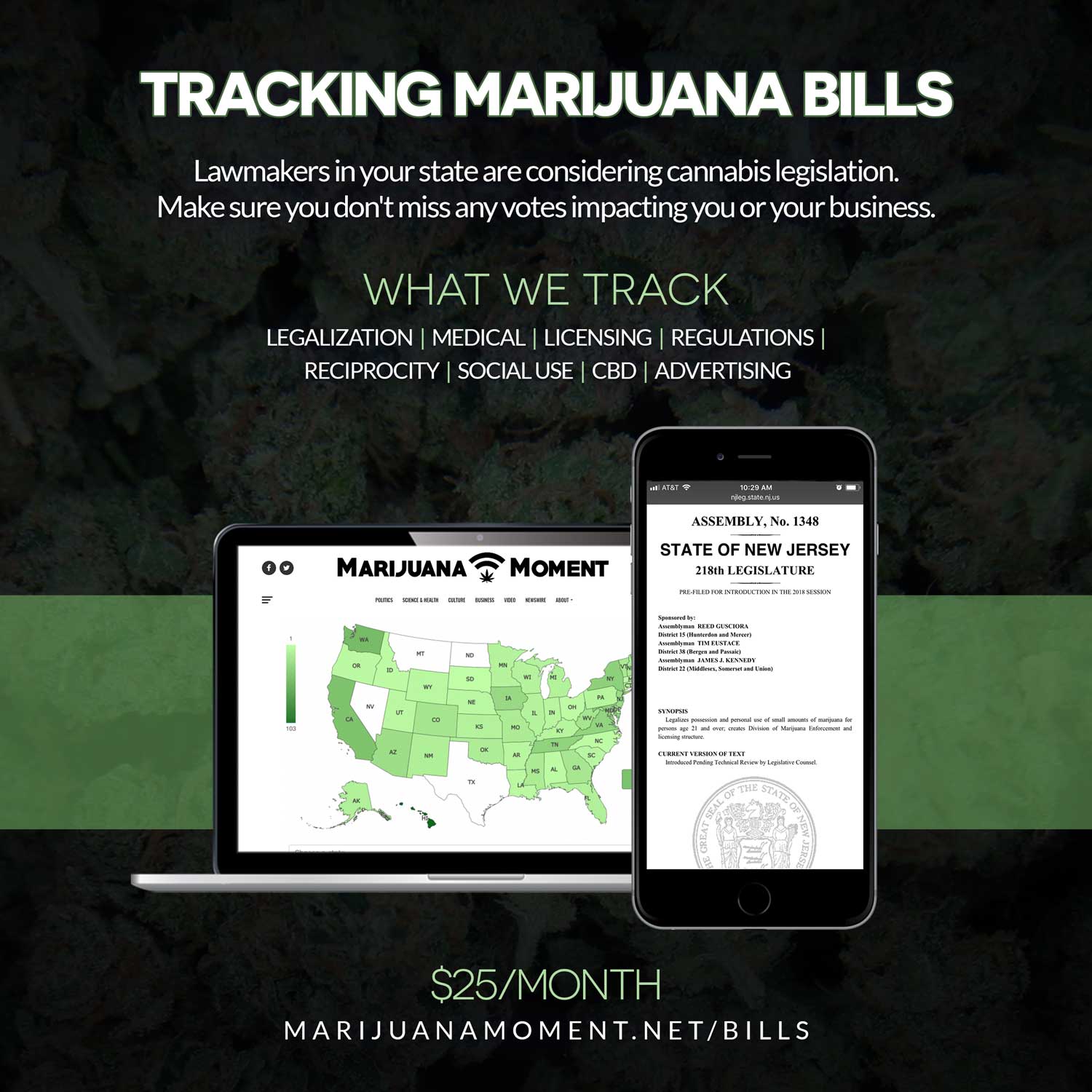
Marijuana Moment is already tracking more than 1,100 cannabis, psychedelics and drug policy bills in state legislatures and Congress this year. Patreon supporters pledging at least $25/month get access to our interactive maps, charts and hearing calendar so they don’t miss any developments.


Learn more about our marijuana bill tracker and become a supporter on Patreon to get access.
—

/ LOCAL

The New Orleans, Louisiana City Council president introduced a marijuana decriminalization proposal.

The Portland, Oregon City Council approved $1.8 million in cannabis revenue-funded grants for equity, restorative justice and community reinvestment programs.

The Riverside County, California Superior Court’s record-keeping policy fails to properly deal with data of minors who have marijuana-related records, a state appeals court found.

Buffalo, New York’s mayor will host a forum for people interested in starting marijuana businesses on Friday.

/ INTERNATIONAL

Mexico’s Supreme Court is reportedly preparing to strike down marijuana criminalization laws in light of lawmakers’ failure to enact a legalization bill on time.

Black people in the UK are twelve times more likely to be prosecuted for marijuana possession than white people are, according to an analysis by the Liberal Democrats.

/ SCIENCE & HEALTH

A study found that “the perceived risk of regular cannabis use is decreasing among older adults.”

A study of mice found that cannabis seed oil treatment “alleviated the endothelial cell damage and lipid deposition induced by a high-cholesterol diet.”

/ ADVOCACY, OPINION & ANALYSIS

The South Dakota Democratic Party tweeted, “More people in South Dakota voted to legalize marijuana than voted for Kristi Noem. The governor then took voters to court in an attempt to overturn our votes to legalize marijuana. #FailedGovernor” It also tweeted, “Has Gov Kristi Noem admitted the election was fair yet? The only stolen election in 2020 was the one where the #People passed #recreational and #medical #cannabis in #SouthDakota & she sued us.. WITH OUR OWN MONEY…  You wanna talk #manipulation & #VoterFraud? #NOem? #NOep?”

The Alabama Democratic Party tweeted, “Across party lines, Americans agree that it is time to #legALize recreational cannabis. In Montana and South Dakota, states with majority GOP leadership, efforts to legalize passed with at least 16 points more support than Pres. Biden received. Now that’s a bipartisan issue!”

Decriminalize Nature posted a conspiracy theory about why it thinks the Indigenous Peyote Conservation Initiative is opposed to decriminalizing peyote.

/ BUSINESS

Cresco Labs Inc. reported quarterly revenue of $178.4 million and a net loss of $24.1 million.

Planet 13 Holdings Inc. reported quarterly revenue of $13.8 million.

JPMorgan Chase & Co. Chairman and CEO Jamie Dimon said, at a House hearing, “I don’t smoke marijuana but if you make it nationally legal, I’m not going to stop our people from banking it.”

GenCanna Acquisition Corp. is suing Vertical Wellness for allegedly reneging on an agreement to provide hemp drying services.

/ CULTURE

Martha Stewart spoke about her CBD products in a TV appearance.

Make sure to subscribe to get Marijuana Moment’s daily dispatch in your inbox.

Marijuana Moment is made possible with support from readers. If you rely on our cannabis advocacy journalism to stay informed, please consider a monthly Patreon pledge.

A Beginner’s Guide To Vape Kit Essentials – – VENTS Magazine

Vaping is another method of breathing in nicotine or other drugs using an electronic device rather than smoking them. If you’re reading this article, you may very well be a beginner looking for more information on vaping and the tools that come with it. As a newcomer to the vaping world, it’s essential to be familiar with what you need to use to have your first taste. To jumpstart your vaping practice, the following are facts you need to know before buying your first kit.   

The E-Cigarette 

If you’re seeing an elongated device that may resemble a pen that people put into their mouths, it’s called a vaporizer or vape. It’s a device people use to consume e-liquids. E-cigarettes make it possible to consume liquids made of propylene glycol, vegetable glycerin, and flavoring.  

These electronic cigarettes come in various wattages that warm the e-liquids to different temperatures, which also affects the flavor. For beginners, you could get a satisfying vape at 10 watts. As you progress, you could eventually start using 40-50 watts. You may visit sites like vape pens at Vapeandjuice.co.uk and other vape shops to check out various vape kits. 

Parts Of The Vape Kit 

Every beginner needs a vape starter kit. An essential part of learning how to vape is to get familiar with the vape hardware used to inhale various liquids. This includes the components and accessories that make up the device. Each part works together to transform liquids into vapors you can smoke and taste.  

  1.  Mouthpiece Or Drip Tip 

The mouthpiece is where you inhale from so the vapor can travel to your lungs. It connects to the main chamber or tank, which contains the e-liquid. The only way for the vapor to come out is to suck it out through this component. 

  1. Tank  

The tank holds the e-liquid of your choice. It can either be made of hard plastic or glass and encases the coil. It’s commonly the body that holds the mouthpiece and the battery underneath.  

Learning about vape basics also includes understanding the different types of substances you could try. Besides e-liquids, there are also buds, oil, and waxes. As you learn more, you’d eventually discover how to inhale them using different vapes. 

  1. Vape Coils 

The vaporizer’s heating element is the wiring shaped like a coil that primarily turns the liquid into vapor. Vaporizers vary as they can have one or two coiled wires. The wick may either be wrapped around or placed in the middle of the coil.  

  1. Wick 

The wick inside the tank is wrapped in the coil. It’s made of different materials, like cotton, mesh, or twisted silica. It’s an absorbent material that holds the liquid heated by the coil and turns it into vapor.  

  1. Atomizer 

The component that holds the coil and the wick can be found inside the tank in standard vape models. More advanced vapes are stand-alone vaporizers.  

  1. Battery 

The battery connects to the tank and holds electricity, which heats the e-liquid inside. There are various sizes of batteries that vapes use, but the most common are 18650 batteries.

How To Buy Your First E-Cigarette 

You’d need a little bit of basic knowledge before buying your first electronic cigarette. Knowing what you want may make it easier for you once you set foot in a smoking shop. Also, you could still always ask the proprietor or staff for recommendations.  

  • Step 1: Choose Your Type Of Vaping 

Since there are a few types of vapes, you may need to figure out first what style of vaping you want to try. This would influence the kind of vaping kit you want to have. There are two styles of vaping: classic and sub-Ohm vaping.  

Classic vaping, also known as mouth to lung (MTL), is a style of vaping where you’d need to inhale the vapor first through your mouth and then to your lungs. It’s suited for beginners as it’s a natural method of consuming substances, much like inhaling a cigarette. It’s also said to be an easier way for smokers to transition to vaping.  

Sub-ohm vaping uses an e-cigarette with a coil whose resistance level is less than 1 ohm. In sub-ohming, you inhale the vapor, and then it goes directly to your lungs, which experienced users tend to do. The vape’s atomizer coil in this case quickly heats up because of low resistance. A more significant amount of liquid vaporizes, producing a more prominent flavor with a thicker cloud of vapor.  

  • Step 2: Decide Which Vaping Kit You Want 

There are two types of MTL devices you could choose from as a beginner. There are classic MTL vaping devices with changeable coils that require replacements and a refillable tank if you see yourself doing mouth-to-lung vaping. It’s perhaps best for those who like more flavor options and customization.  

Cigalike MTL vaporizers are another excellent choice for beginners because of their affordability. They have a disposable flavored refill, like menthol. And they look similar to traditional cigarettes and are thought to be easier to use. E-liquid flavor ranges include tobacco, which has varying nicotine strengths. 

Another type of vaporizer is a direct-to-lung (DTL) device, like a sub-ohm vaporizer. This device is for more experienced users who have long moved on from smoking to vaping. The device is also customizable, allowing the user to set it to cater to personal tastes.  

  •  Step 3: Choose An E-Liquid To Inhale 

Once you’ve already picked out your vaping kit, you’d be going through various e-liquids or refills to inhale and taste. These also come with nicotine with varying strengths, if you prefer them to e-liquids.  

In Conclusion 

Vaping is a fast-growing practice that’s believed to be less harmful than smoking. If you want to start the habit, knowing the vaporizer parts would allow you to understand how it works and how you could eventually enjoy vaping more. And when you’ve gotten used to vaping, you may also use modified devices to find the tastes you like, like what veteran users do. 

Why The Coronavirus Pandemic Was a Breakout Moment for the Cannabis Industry – The New York Times

This article is part of Owning the Future, a series on how small businesses across the country have been affected by the pandemic.

“I expect this will be the first year Nevada does over a billion in cannabis sales,” said Nicolas MacLean, chief executive of Aether Gardens, a cannabis producer in Las Vegas. “And it happened on the back of what I think no one expected.”

Last March, the Strip went dark in its first total shutdown since the assassination of the Rev. Dr. Martin Luther King Jr. in 1968. In the ensuing weeks, Las Vegas became the layoff epicenter of the United States. With casinos closed, visitor volume dropped to a little over 100,000 in April 2020 from 3.5 million in January 2020. The decrease sent the state’s small businesses — including the cannabis sector — into a tailspin.

“That first week, the government didn’t differentiate between essential and nonessential businesses,” Mr. MacLean said. “Dispensaries went into panic mode, asking if they could send product back to us.” (Recreational marijuana is legal in Nevada, though only licensed dispensaries may sell it.) Inside Aether Gardens, a 120,000-square-foot space 14 miles off the Strip, Mr. MacLean and his staff marveled at their latest harvest.

“We’d spent the last year perfecting our flower,” Mr. MacLean said, “and we got caught in the middle of Covid with the best flower we’d ever had.”

At the time, the company was offering the Dosi-Woah, a calming strain in which the indica species is dominant, with buds in a mix of green, gold and bright orange. It also had Zweet Insanity, a strain rich in terpenes, the compounds responsible for the plant’s often powerful scent, with big, greasy blooms that provide a relaxing effect. Both varieties also deliver the high levels of the psychoactive compound tetrahydrocannabinol (THC) that hard-partying visitors seek. But with none of those customers in town, Mr. MacLean saw cannabis through a new lens: How could it help with pandemic-related stress and anxiety?

Apparently, quite a bit. Despite inconsistent public health orders from state and local governments about whether cannabis companies would be considered “essential,” the industry had a breakout moment during the pandemic. Legal cannabis sales in the United States passed $17.5 billion in 2020, a 46 percent increase over sales in 2019. For many Americans, stocking up on marijuana was as essential as stocking up on toilet paper. And the industry found a way to get it to them.

In Las Vegas, that meant engaging local residents. Five days after Gov. Steve Sisolak issued his first emergency declaration, the Nevada Health Response COVID-19 Risk Mitigation Initiative announced that licensed cannabis stores and medical dispensaries could remain open, but encouraged delivery business and social distancing. Mr. MacLean remembers lines of cars, five blocks long, waiting for curbside pickup. While Nevada businesses had always bet on tourism dollars, Las Vegas’s metropolitan population of two million year-round residents suddenly looked like a strong replacement-customer base.

“Locals are very discerning — they want something they aren’t going to find on the black market,” he said. “Especially when you are stuck at home, you’re paying more attention to things like terpene and cannabinoid profiles, on top of THC levels, bud structure and aroma, which is information you get when buying from the legal market. And last year, that played into our hand as a high-quality flower cultivator.”

To meet the growing demand, Aether Gardens built a new state-of-the-art greenhouse, which will deliver its first harvest this month. Tourists (and their discreet vape pens) are coming back, but Mr. MacLean doesn’t anticipate that local business — or the demand for premium flower — will go away anytime soon.

Oswaldo Graziani Lemoine, the creative director of the Florida-based company Fluent Cannabis Care, saw a similar demand for flower when the pandemic hit. But he knew exactly who was buying: the half a million or so Florida residents who hold medical cannabis cards. (Adult recreational use is not legal in the state.) The question was, how would Fluent manage retail during the pandemic?

“Florida is a place where mask-wearing gets political,” Mr. Graziani said, “so even though we were able to keep our 19 locations open, we incentivized online orders and curbside pickup.” That included deals like Silver Sundays (10 percent off for ages 55 and older), Student Saturdays (10 percent off with a student ID) and, throughout the week, 20 percent off express pickup (curbside pickup of online orders) for new customers.

“For us, it became less about the in-store experience and more about offering our customers deals and the ease of pickup,” Mr. Graziani said. As the company looks to future expansion, he is imagining stores that are exclusively for express pickup: no lobby, no counter, just preorder and drive-through.

“If you don’t like roadblocks thrown at you all the time, like a video game, this is not the industry for you,” said Meg Sanders, chief executive of the Massachusetts-based Canna Provisions. In March 2020, the hurdles came fast and furious. Though recreational marijuana use is legal there, Massachusetts is the only state to distinguish between medical cannabis distributors and adult-use retailers, which meant that dispensaries like Canna Provisions had 48 hours’ notice to shut down.

“To have liquor stores deemed essential and not adult-use cannabis — especially when the law passed in Massachusetts was about regulating cannabis like alcohol — was surprising and unfortunate,” Ms. Sanders said. After paying all of her employees for an additional two weeks and coming to terms with the fact that the cannabis businesses were not eligible for Paycheck Protection Program loans, she took a hard look at her business model and began to sketch out a way forward.

“We immediately understood that our way of interacting with our customer would have to change, Ms. Sanders said, describing the focus at the Canna Provisions dispensary in Lee, Mass., as education-focused personalized service. Located in the heart of Berkshire County, where nearly three million visitors come every year for leaf peeping, skiing and picnicking, “our store is very much part of the experience,” she added.

In contrast to the traditional deli-counter-style dispensary, Canna Provisions has thrived on interactive, guide-led group shopping. “Our average customer age is 50 or over,” Ms. Sanders said. “They have questions, they want to learn, they don’t want to feel rushed because there is a line growing behind them.” Prepandemic, Canna Provisions had as many as eight guides on the floor at a time, educating groups on topicals, brownies and prerolled joints. But during the pandemic, that atmosphere of weed-focused learning vanished.

“Picture that transaction in a parking lot, with two people wearing masks, six feet apart, and it’s just not the same,” Ms. Sanders said.

Canna Provisions faced another obstacle when it eventually reopened, with limited curbside pickup, two months after the shutdown. “Our county is an internet desert, so we had to help people that didn’t have access or didn’t have the computer skills they might need to preorder online., Ms. Sanders said. Facing this reality, she transferred her operations to telephone orders to preserve the human and educational touch that customers had grown comfortable with.

When clients call Canna Provisions, the first voice they hear is that of an adept bud tender — sometimes Ms. Sanders herself — who guides them through the shopping experience. From suggesting strains — like the locally grown Stardawg (Corey Cuts) Smash Hits, a relaxing and uplifting hybrid with “a tendency to turn philosophical,” as the company’s website puts it — to processing the order, each phone guide provides the same dedicated attention that clients would experience at the shop.

“And it’s working,” Ms. Sanders said. “In our Lee store, preorders have become almost 100 percent of our business, so we bought more handsets and hired more people to answer the phones, and our revenue is up.”

When Covid restrictions for retail operations eased last summer, Canna Provisions opened its second shop, inside a 150-year-old brick paper mill in Holyoke, Mass. At the new 4,000-square-foot location, Ms. Sanders and her team can once again offer their guide-led customer-service experience. She described the way cannabis tourists explore the space and take in all the curious design elements: antique rubber stamps, reclaimed metal signs and the figurine of a T. rex smoking a joint.

“We set out to make a destination,” she said. “And we nailed it.”

Why the Pandemic Was a Breakout Moment for the Cannabis Industry – The New York Times

This article is part of Owning the Future, a series on how small businesses across the country have been affected by the pandemic.

“I expect this will be the first year Nevada does over a billion in cannabis sales,” said Nicolas MacLean, chief executive of Aether Gardens, a cannabis producer in Las Vegas. “And it happened on the back of what I think no one expected.”

Last March, the Strip went dark in its first total shutdown since the assassination of the Rev. Dr. Martin Luther King Jr. in 1968. In the ensuing weeks, Las Vegas became the layoff epicenter of the United States. With casinos closed, visitor volume dropped to a little over 100,000 in April 2020 from 3.5 million in January 2020. The decrease sent the state’s small businesses — including the cannabis sector — into a tailspin.

“That first week, the government didn’t differentiate between essential and nonessential businesses,” Mr. MacLean said. “Dispensaries went into panic mode, asking if they could send product back to us.” (Recreational marijuana is legal in Nevada, though only licensed dispensaries may sell it.) Inside Aether Gardens, a 120,000-square-foot space 14 miles off the Strip, Mr. MacLean and his staff marveled at their latest harvest.

“We’d spent the last year perfecting our flower,” Mr. MacLean said, “and we got caught in the middle of Covid with the best flower we’d ever had.”

At the time, the company was offering the Dosi-Woah, a calming strain in which the indica species is dominant, with buds in a mix of green, gold and bright orange. It also had Zweet Insanity, a strain rich in terpenes, the compounds responsible for the plant’s often powerful scent, with big, greasy blooms that provide a relaxing effect. Both varieties also deliver the high levels of the psychoactive compound tetrahydrocannabinol (THC) that hard-partying visitors seek. But with none of those customers in town, Mr. MacLean saw cannabis through a new lens: How could it help with pandemic-related stress and anxiety?

Apparently, quite a bit. Despite inconsistent public health orders from state and local governments about whether cannabis companies would be considered “essential,” the industry had a breakout moment during the pandemic. Legal cannabis sales in the United States passed $17.5 billion in 2020, a 46 percent increase over sales in 2019. For many Americans, stocking up on marijuana was as essential as stocking up on toilet paper. And the industry found a way to get it to them.

In Las Vegas, that meant engaging local residents. Five days after Gov. Steve Sisolak issued his first emergency declaration, the Nevada Health Response COVID-19 Risk Mitigation Initiative announced that licensed cannabis stores and medical dispensaries could remain open, but encouraged delivery business and social distancing. Mr. MacLean remembers lines of cars, five blocks long, waiting for curbside pickup. While Nevada businesses had always bet on tourism dollars, Las Vegas’s metropolitan population of two million year-round residents suddenly looked like a strong replacement-customer base.

“Locals are very discerning — they want something they aren’t going to find on the black market,” he said. “Especially when you are stuck at home, you’re paying more attention to things like terpene and cannabinoid profiles, on top of THC levels, bud structure and aroma, which is information you get when buying from the legal market. And last year, that played into our hand as a high-quality flower cultivator.”

To meet the growing demand, Aether Gardens built a new state-of-the-art greenhouse, which will deliver its first harvest this month. Tourists (and their discreet vape pens) are coming back, but Mr. MacLean doesn’t anticipate that local business — or the demand for premium flower — will go away anytime soon.

Oswaldo Graziani Lemoine, the creative director of the Florida-based company Fluent Cannabis Care, saw a similar demand for flower when the pandemic hit. But he knew exactly who was buying: the half a million or so Florida residents who hold medical cannabis cards. (Adult recreational use is not legal in the state.) The question was, how would Fluent manage retail during the pandemic?

“Florida is a place where mask-wearing gets political,” Mr. Graziani said, “so even though we were able to keep our 19 locations open, we incentivized online orders and curbside pickup.” That included deals like Silver Sundays (10 percent off for ages 55 and older), Student Saturdays (10 percent off with a student ID) and, throughout the week, 20 percent off express pickup (curbside pickup of online orders) for new customers.

“For us, it became less about the in-store experience and more about offering our customers deals and the ease of pickup,” Mr. Graziani said. As the company looks to future expansion, he is imagining stores that are exclusively for express pickup: no lobby, no counter, just preorder and drive-through.

“If you don’t like roadblocks thrown at you all the time, like a video game, this is not the industry for you,” said Meg Sanders, chief executive of the Massachusetts-based Canna Provisions. In March 2020, the hurdles came fast and furious. Though recreational marijuana use is legal there, Massachusetts is the only state to distinguish between medical cannabis distributors and adult-use retailers, which meant that dispensaries like Canna Provisions had 48 hours’ notice to shut down.

“To have liquor stores deemed essential and not adult-use cannabis — especially when the law passed in Massachusetts was about regulating cannabis like alcohol — was surprising and unfortunate,” Ms. Sanders said. After paying all of her employees for an additional two weeks and coming to terms with the fact that the cannabis businesses were not eligible for Paycheck Protection Program loans, she took a hard look at her business model and began to sketch out a way forward.

“We immediately understood that our way of interacting with our customer would have to change, Ms. Sanders said, describing the focus at the Canna Provisions dispensary in Lee, Mass., as education-focused personalized service. Located in the heart of Berkshire County, where nearly three million visitors come every year for leaf peeping, skiing and picnicking, “our store is very much part of the experience,” she added.

In contrast to the traditional deli-counter-style dispensary, Canna Provisions has thrived on interactive, guide-led group shopping. “Our average customer age is 50 or over,” Ms. Sanders said. “They have questions, they want to learn, they don’t want to feel rushed because there is a line growing behind them.” Prepandemic, Canna Provisions had as many as eight guides on the floor at a time, educating groups on topicals, brownies and prerolled joints. But during the pandemic, that atmosphere of weed-focused learning vanished.

“Picture that transaction in a parking lot, with two people wearing masks, six feet apart, and it’s just not the same,” Ms. Sanders said.

Canna Provisions faced another obstacle when it eventually reopened, with limited curbside pickup, two months after the shutdown. “Our county is an internet desert, so we had to help people that didn’t have access or didn’t have the computer skills they might need to preorder online., Ms. Sanders said. Facing this reality, she transferred her operations to telephone orders to preserve the human and educational touch that customers had grown comfortable with.

When clients call Canna Provisions, the first voice they hear is that of an adept bud tender — sometimes Ms. Sanders herself — who guides them through the shopping experience. From suggesting strains — like the locally grown Stardawg (Corey Cuts) Smash Hits, a relaxing and uplifting hybrid with “a tendency to turn philosophical,” as the company’s website puts it — to processing the order, each phone guide provides the same dedicated attention that clients would experience at the shop.

“And it’s working,” Ms. Sanders said. “In our Lee store, preorders have become almost 100 percent of our business, so we bought more handsets and hired more people to answer the phones, and our revenue is up.”

When Covid restrictions for retail operations eased last summer, Canna Provisions opened its second shop, inside a 150-year-old brick paper mill in Holyoke, Mass. At the new 4,000-square-foot location, Ms. Sanders and her team can once again offer their guide-led customer-service experience. She described the way cannabis tourists explore the space and take in all the curious design elements: antique rubber stamps, reclaimed metal signs and the figurine of a T. rex smoking a joint.

“We set out to make a destination,” she said. “And we nailed it.”